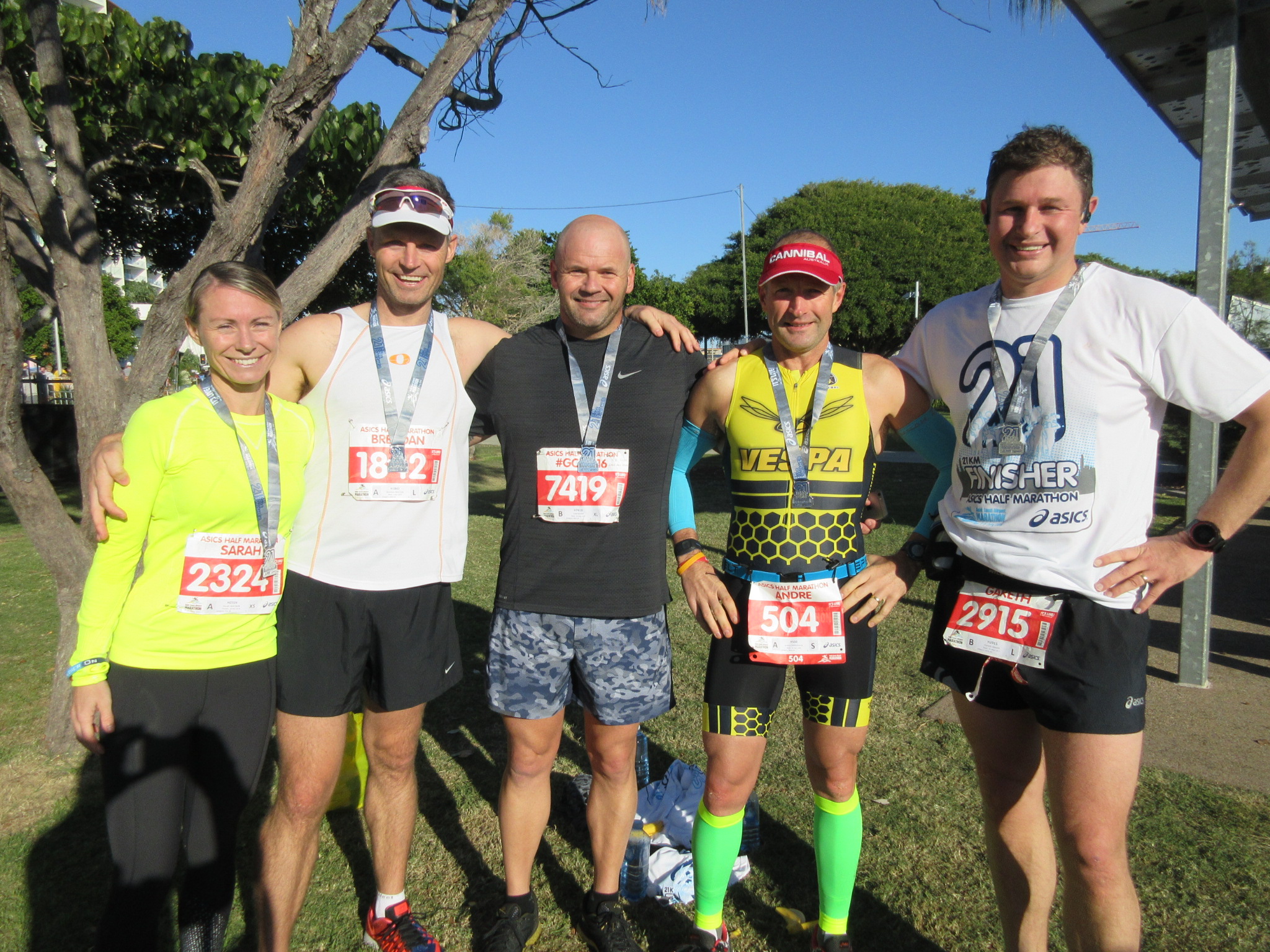
As a marathoner, I struggled for six years wondering why I could never lose the belly I had around my waist. I was following the prescribed low-fat, high-carb diet, running 70 kilometers a week and, at 48 years old, doing a 3:45 marathon. Yet I was always hungry and had to get two massages a week for sore calves.
Then, two years ago, I attended a talk given by Dr. Stephen Phinney.
While what Phinney said went completely against the conventional wisdom of sports nutrition and, admittedly, my own belief system, he mentioned that Dr. Timothy Noakes had made a complete 180-degree reversal of his previous stance on nutrition and successfully corrected his progression of Type-2 diabetes.
This struck me, as Noakes is a legend in sports science and was willing to say, “I was wrong.” As my carbohydrate-centric approach was not working, I decided I would give a fat-fueled approach a try.
I did my research and settled on a fat-adapted approach called OFM (Optimized Fat Metabolism), which is mentioned in Dr. Phinney and Dr. Volek’s book “The Art and Science of Low Carbohydrate Performance.”
Two years after making the change, I am a lean 141 pounds and have no inflammation that requires therapy.
My oxidation has shifted from 65 percent of VO2 max to 85 percent of VO2 max, and my lactate threshold has reached 90 percent of max HR instead of the 72 percent I had when I was a carbivore. More importantly, my cholesterol values have improved, with my HDL almost doubling and my triglycerides plummeting to a quarter of what they were in my high-carb days.
Now, as a triathlon/marathon coach, I have seen my clients with the same fat-phobic belief system become fat adapted. They lose the weight and are less injured, more mentally and emotionally balanced, and less stressed. Just as importantly, they perform better not only in their sport but also in every aspect of their lives.
It seems that Dr. Phil Maffetone and six-time Ironman World Champion Mark Allen were onto something decades ago, as the concept of fat adaptation has made a resurgence.
This time, however, it’s here to stay. Endurance athletes are not only winning and setting records on a fat-based approach, but now there is also actual published science to support the real-world results. As the saying goes, “what’s new is old.”
In March 2016, the first paper to come out of the FASTER Study (Volek et.al.) was published in the journal “Metabolism.” While early adopters did not wait for the science, the results now provide compelling reasons for endurance athletes to consider the shift toward fat as fuel.
This may come as a shock to many of you because these results challenge the conventional wisdom of the last 40 years.


Another paper, “Rethinking the role of fat oxidation: substrate utilization during high-intensity interval training in well-trained and recreationally trained runner” (Hetlelid et.al.), published online in August 2015, suggests that the role of fat oxidation is at higher intensities than previously thought. The nuggets from this study include:
While Maffetone’s development of the maximum aerobic function (MAF) test represented a game-changer in its day, it never received the credit it deserved for giving Allen that critical edge in performance.
The fat-adaptation strategies in use today are much more robust models, which not only emphasize aerobic base training but also training in higher zones specifically to increase fat-adaptation at higher intensities — both of which are well established in endurance training.
However, it is the sharply carbohydrate-restricted dietary shift that induces a key physiological shift in energy substrate utilization.
Coupled with physical activity commensurate with triathlon training, this dietary shift creates a synergistic adaptation to tap into fat as fuel at levels previously not thought possible.
Current observation suggests that once this shift is in place, the window of carbohydrate tolerance for most athletes is much wider than for a sedentary person adhering to a strict ketogenic diet, and thus, some level of carbohydrates can be strategically brought back into the diet as fuel for performance.
However, this quantity is far less than the massive amounts of carbohydrates of a conventional diet for endurance athletes. While more research is needed, empirical observation suggests that most triathletes will be seeing a 30 to 80 percent reduction in the calories necessary to fuel their training and racing, obtain consistently better performance, and have a faster recovery.
It is important to note that the LCD cohort from the FASTER study trains and races by following the Optimized Fat Metabolism (OFM) program and not the strict ketogenic diet they were on during the data collection for FASTER.
Ketosis is the foundation of OFM. While science is a wonderful tool, well-designed scientific studies control variables, while the real world is a very different and dynamic environment.
Fat adaptation presents both challenges and tremendous opportunities. It is disruptive change at its finest. If you’ve been following the current dietary guidelines and they aren’t working for you, do your own research and seek help from health professionals who understand the benefits of a low-carb lifestyle.
The views expressed in this article are the opinion of the author and not necessarily the practices of USA Triathlon. Before starting any new diet or exercise program, you should check with your physician and/or coach.
http://www.metabolismjournal.com/article/S0026-0495(15)00334-0/pdf
http://bmjopensem.bmj.com/content/1/1/e000047.full
Peter Defty has a B.S. in biology from the Plant Science University of California. He is a Davis General Manager at VESPA Power Products, a developer of VESPA's Optimized Fat Metabolism (OFM) program.
Doctors Stephen Phinney, M.D., Ph.D., and Jeff Volek RD, Ph.D., two of the world's leading researchers in ketogenic diets, took notice and made a point to discuss Defty's work on Optimized Fat Metabolism (OFM) in "The Art & Science of Low Carbohydrate Performance" as well as use his pool of OFM athletes for research studies.
Doctors Stephen Phinney, MD / PhD and Jeff Volek RD / PhD , two of the World’s leading researchers in Ketogenic Diets, took notice and made a point to discuss Peter’s work on Optimized Fat Metabolism (OFM) in “The Art & Science of Low Carbohydrate Performance” as well as use his pool of OFM athletes for research studies.
Andre Obradovic is an ICF Leadership PPC Level Coach, A Primal Health Coach, a Certified Low Carb Healthy Fat Coach, & a Certified Personal Trainer. Andre is also a Founding member of the Dr. Phil Maffetone MAF certified Coach. He is an Ambassador for the Noakes Foundation, and a regular subject matter expert lecturer for the Nutrition Network (a part of the Noakes Foundation) Andre has completed 16 x 70.3 Ironmans and in 2017 he competed in the 70.3 Ironman World Championships. He has completed 18 Marathons and over 30 Half Marathons. Andre currently focuses his athletic competition on Track and Field with the occasional Marathon.




I was listening to you on the Effortless Swimming podcast and I'm interested in the nutritional & training advantages of this shift towards healthy fats. I've previously done marathons and half-marathons but I'm returning after a hiatus of a couple years. Currently 5'7" and just under 70kg, and dropping weight the traditional way. I've been working on my swim technique and endurance and would like to try a half-ironman in the next year. Looking forward to following you on social media/youtube!
David thank you for your comments. If I can help you please let me know..